weitere Beiträge in dieser Kategorie...

Make or Buy? - Press release
THE QUESTION OF VERTICAL INTEGRATION NEEDS TO BE REASSESSED.
AUMAT REVOLUTIONIZES MECHANICAL ENGINEERING WITH 3D PRINTING

Press release from the 3D Printing Solingen network
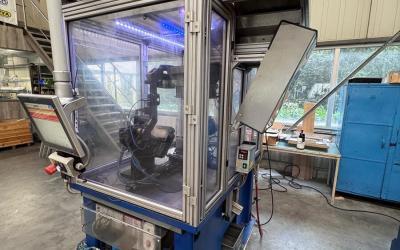
Our network member, AUMAT, a mechanical engineering company based in Solingen, specializes in high-quality broaching machines, machinery for the cylinder lock industry, and special-purpose machines for customized automation solutions. By now, every machine produced includes numerous functional parts from the 3D printer—and the trend is rising.
“When we purchased our first 3D printer, the potential cost savings and the acceleration of manufacturing individual functional parts were initially the main focus,” emphasizes Dipl.-Ing. Achim Ihlefeld, the company’s Technical Director. “We were able to achieve this goal after just a few months; 3D printing has long since paid for itself. The often time-consuming outsourcing of individual machine parts was minimized in favor of faster processes.”
In the meantime, another beneficial effect is becoming increasingly noticeable. AUMAT machines are becoming even better, more innovative, and more powerful through 3D printing. The freedom of form and design offered by 3D printing enables solutions that were previously not possible at all or were disproportionate for cost reasons. Machine parts such as protective covers, extraction hoods, cable guides, spiral conveyors, and much more are optimally planned, designed, and used for their intended purpose. It also allows much more flexible responses to individual customer requirements.
Make-or-buy questions are being reconsidered and answered anew at AUMAT
With three 3D printers used by AUMAT to manufacture machine parts in-house more cost-effectively and efficiently—parts that were previously purchased—the level of vertical integration inevitably increases as well. As early as the planning and design phase of new machines, 3D printing increasingly raises the make-or-buy decision for more and more components. However, additive manufacturing is not an end in itself. According to business criteria, the 3D-printed part must prove superior to traditional in-house and outsourced manufacturing. This also applies to the 3D printing processes themselves. AUMAT works with so-called FDM printers (Fused Deposition Modelling). However, if certain technical material requirements cannot be met with the company’s own 3D printers, but can be achieved, for example, through selective laser sintering, AUMAT awards contracts to appropriately specialized 3D printing service providers—provided this makes economic sense.
Achim Ihlefeld is certain that development has only just begun: “The pace of further expansion of 3D printing in mechanical engineering depends on whether and when the performance of 3D printers and the materials used can be increased to such an extent that the industry’s specific, high requirements are met. If further progress is made with regard to elasticity, strength, hardness, thermal behavior, abrasion and wear, etc., many more machine parts could soon come from the 3D printer.”
Lower costs, fast flexible solutions, and new creative approaches—the experience gained is also offered by AUMAT Maschinenbau GmbH to other companies in the form of 3D printing design and engineering services. This includes the complete execution and management of development projects using 3D CAD systems, from design and prototypes through to production readiness.
Further information:
Dipl.-Ing. Achim Ihlefeld
Technical Director
AUMAT GmbH
Kyllmannweg 19 – D-42699 Solingen
Tel.: +49(0)212-38245-0 – Fax: +49(0)212-38245-24
Email: info@aumat.de – Web: www.aumat.de