
Fully automated lock assembly system
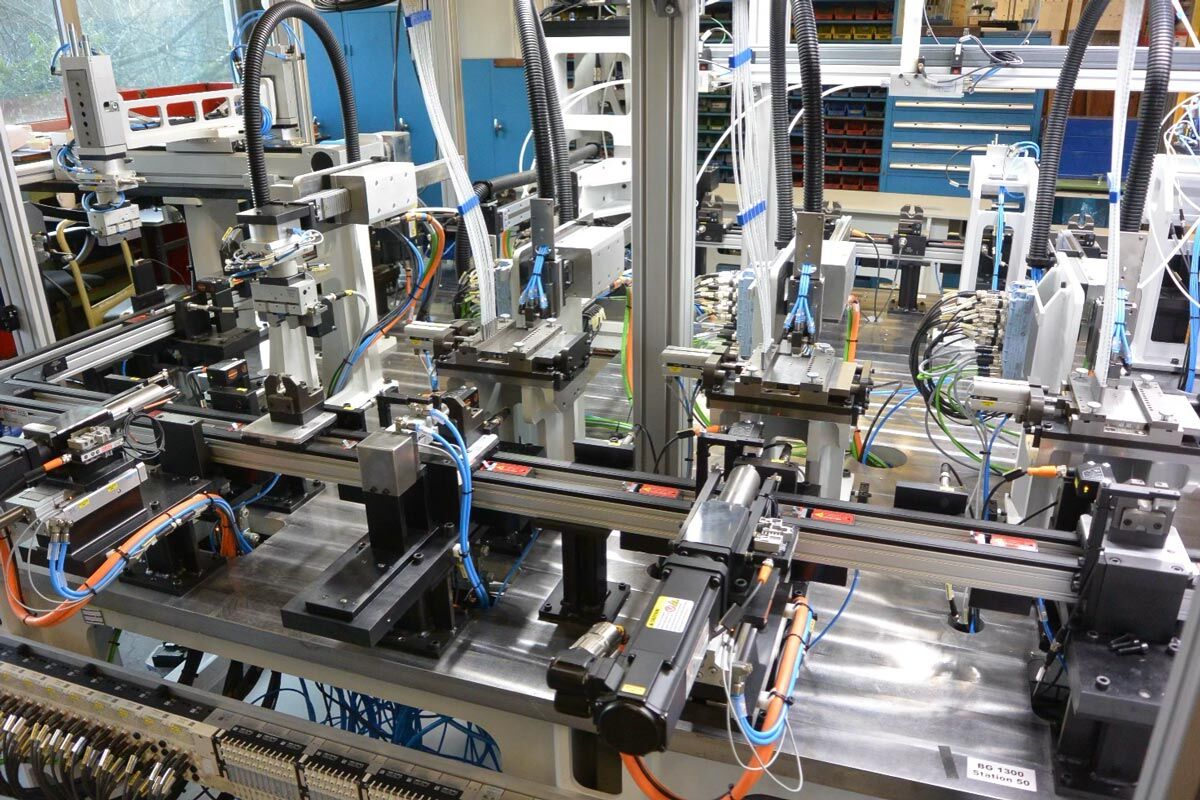
Linear transfer system – vacuum technology
Fully automated cylinder lock assembly system with a capacity of 360 cylinders per hour
Text quoted from: "Sorting as if by magic – AUMAT, a company from Kyllmannweg, builds fully automated systems for lock assembly." Solinger Tageblatt, 4 January 2013, by Thomas Kind
Each lock in a locking system is a high-tech one-off with more than 100 individual components.
Manually loading the cylinders is prone to errors. The aim is therefore the highest possible degree of automation: "Fully automated feeding ensures greater process reliability," says the Technical Director, Dipl.-Ing. Achim Ihlefeld.
Manual interventions have therefore been reduced to an absolute minimum. The lock cylinders – pre-picked with matching keys in transport containers – are now only placed into the workpiece carriers by hand. This cannot be automated efficiently, as lock cylinders vary too much. The possible length combinations alone result in more than 2,500 variants.
After scanning the corresponding order, the machine knows what it has to do. A mini paternoster conveys the workpieces to the first processing station. A precise linear system accurate to 1/100 mm handles transport to 15 different feeding stations.
Each cylinder is measured with laser assistance. At the filling stations, servo-controlled "Pick & Place" units with vacuum hoses pick up tiny housing pins and then blow them, using compressed air, precisely into the correct pin bore. Camera systems then check each individual cylinder to ensure it has been filled correctly. If the result is positive, the bores are sealed with tiny plugs using up to one tonne of pressing force. At the end of the processing chain, a robot arm picks up the housings and places them with the matching key.
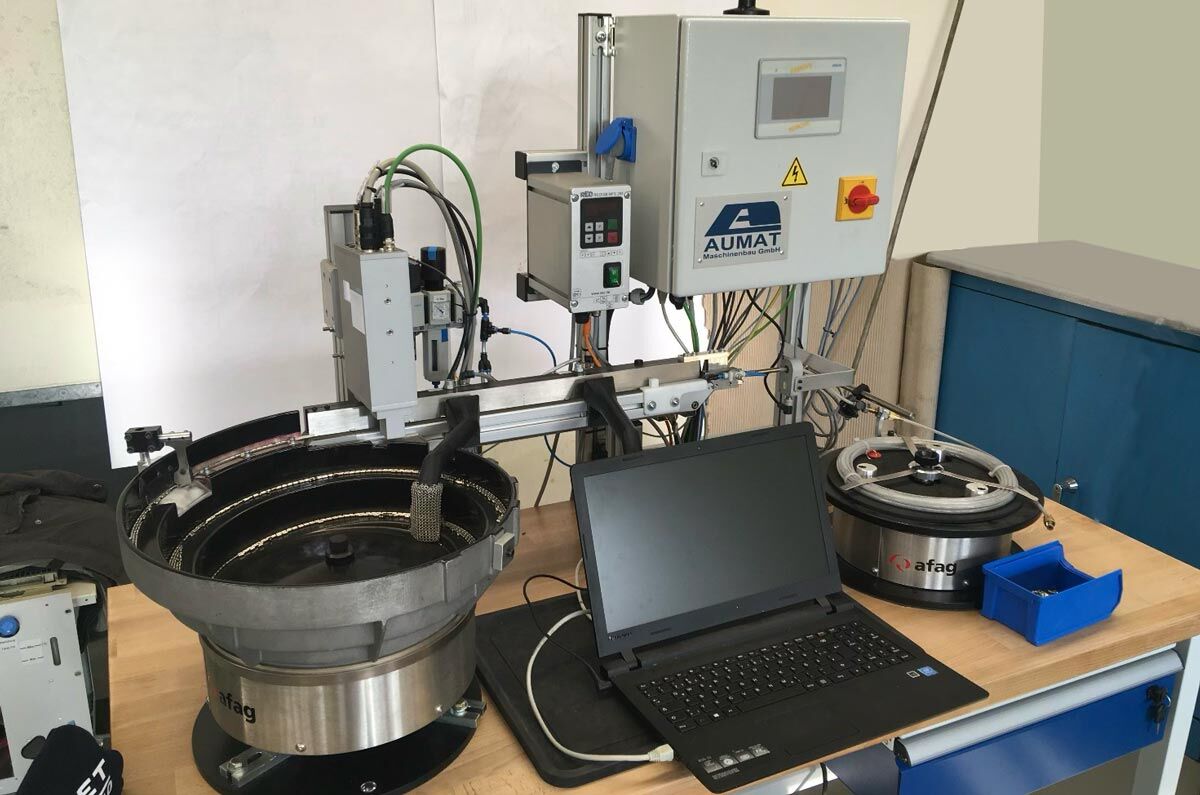
The locking-system machine has a capacity of 360 cylinders per hour. A special feature is the "oscillating feeder bowls" developed by Aumat itself: they can sort a pile of thousands of tiny housing pins by means of a controlled 50 Hz oscillation and feed them into the production process in the correct orientation in a controlled manner.
The small bowls, around ten centimetres in size, with an internal spiral structure in which the pins slowly migrate upwards, were produced using the so-called "rapid prototyping process" with a 3D printer.
Videos in the following order: 1. Automatic keying alike • 2. Transfer system • 3. Feeding the pins